Most service business owners think about hiring when they feel the pressure of too much work. More leads to follow up with, more clients to onboard, more invoices to chase, more reports to pull. The instinct is to add a person.
The better question is: how much of that work should never touch a human in the first place?
Research shows that 94 percent of companies run repetitive manual tasks that current automation tools could handle. The businesses winning right now are not necessarily bigger or better staffed. They have systems doing the work that used to require a person.
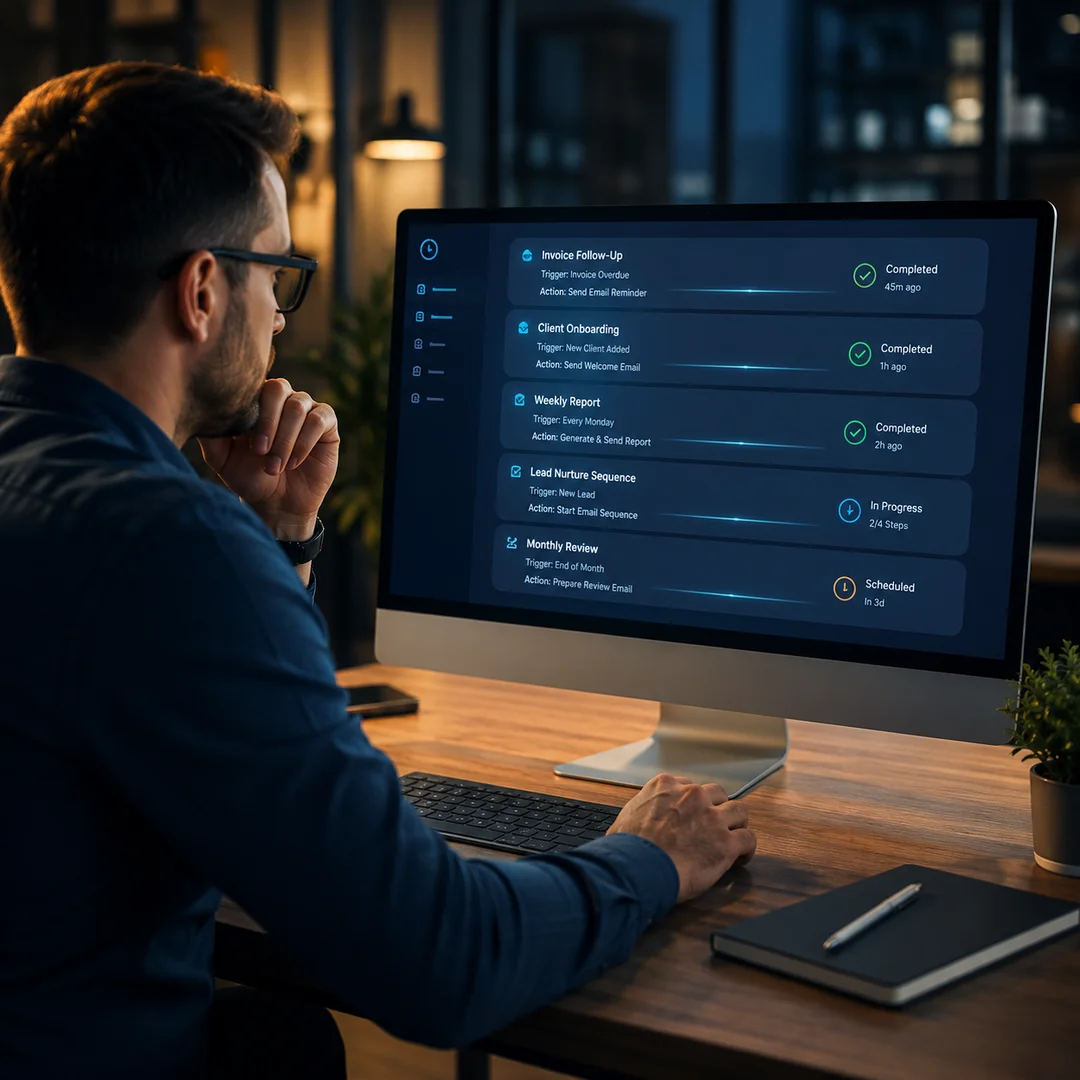
Here are the five back office workflows that pay for themselves fastest for service businesses.
S: The Problem Every Service Business Owner Knows
You built the business. You landed the clients. Now you spend a significant part of every week doing work that is not why you started the company.
Building the weekly pipeline report on Sunday night. Following up on the invoice that has been sitting unpaid for three weeks. Trying to remember to email the client who signed up two weeks ago to check how onboarding is going. Asking for a Google review and then forgetting to actually send the message.
None of that work is hard. All of it is necessary. And almost all of it can be done without you.
Every hour you spend on back office admin is an hour not spent on selling, building, or serving clients. At owner-level billing rates, three hours of manual reporting and follow-up work per week costs your business $150 to $400 in real opportunity cost every single week.
That is before you count the revenue that slips through because the follow-up did not go out.
C: What the Manual Version Actually Costs
The numbers are specific enough to be useful here.
Businesses processing invoices manually pay an average of $12.44 per invoice. Businesses using automated billing workflows pay $4.98. For a service company sending 40 invoices per month, that is a difference of $298 per month in direct cost, plus the revenue risk from payments that are late or never chased at all.
Manual client onboarding, where someone on your team sends welcome emails, shares documents, and schedules check-ins by hand, takes two to four hours per new client. At $50 per hour loaded cost, a business onboarding eight new clients per month spends $800 to $1,600 per month on a process that a workflow handles in minutes.
The reporting problem is harder to quantify but just as real. A business owner spending three hours every week building a report manually spends over 150 hours per year on a task that an automated dashboard handles without any human time. That is nearly four full work weeks reclaimed every year.
Add up manual reporting, manual onboarding, manual invoice follow-up, and missed review requests, and most service businesses are leaving $40,000 to $60,000 in avoidable admin cost and missed revenue on the table annually.
A: The 5 Workflows That Fix It
1. Automated Weekly Reporting
A business that cannot see its numbers in real time cannot make good decisions. But most small service businesses only know their numbers when someone takes time to pull them.
An automated reporting workflow connects your CRM, booking system, and payment processor and sends a formatted weekly summary every Monday morning before you open your laptop. New leads. Open pipeline. Revenue collected. Appointments booked. No spreadsheet. No Sunday night scramble.
GoHighLevel's reporting dashboard, connected to a simple workflow trigger, handles this for most service businesses without a custom build. More complex reporting setups can route data through n8n into a Google Sheet or Airtable dashboard that updates in real time.
When you always know your numbers, you stop reacting and start running the business.
2. Client Onboarding Sequences
The first two weeks of a client relationship determine whether they refer you or quietly move on. A bad onboarding experience does not always produce a complaint. It produces silence, which costs you referrals you will never know you lost.
An automated onboarding sequence triggers the moment a new client signs or pays. It sends a welcome message with everything they need to get started. It schedules a check-in at day three. It delivers the relevant resources at day seven. It asks how things are going at day fourteen.
None of that requires a person. All of it makes the client feel like you run a professional operation that has done this before.
For Skyland Studios, PrismAgent's first major client, a multi-step onboarding and communication sequence replaced what had previously been a manual process spread across email threads and reminders. The result was a consistent client experience that the team could scale without adding headcount.
3. Invoice and Payment Follow-Up
Late payments are a cash flow problem disguised as an admin problem. Most service businesses are not collecting late because clients refuse to pay. They are collecting late because the reminder never went out, or it went out once and nobody followed up.
An automated payment sequence sends an invoice confirmation the day the invoice is issued. It sends a friendly reminder three days before the due date. It sends a gentle follow-up one day after. It escalates at seven days overdue with a firmer message and a direct payment link.
Every one of those messages goes out automatically. You see the dashboard. You collect faster. You stop having awkward conversations about money.
4. Review Request Automation
Reviews drive new business for service companies more directly than almost any other factor. A single Google review influences the buying decision of 93 percent of new customers. Most service businesses collect reviews at a fraction of the rate they could because the request never went out at the right moment.
An automated review request triggers when a job is marked complete or a payment is collected. The message goes to the client within 24 hours while the experience is still fresh. It includes a direct link to your Google Business Profile or Facebook page.
Businesses that automate review requests typically see three to five times the review volume compared to manual or ad-hoc requests. That volume directly impacts search ranking and inbound lead quality.
5. Dead Lead and Past Client Reactivation
This is the highest-return workflow most service businesses have never built.
Your CRM is full of people who expressed interest and went quiet, or clients who worked with you once and never came back. They are not gone. They are just not being reached.
A reactivation sequence identifies contacts with no activity in the past 90 days and sends a short, direct message. Not a promotional blast. A personal-sounding check-in: "Are you still dealing with [problem]? We have been working with a few [industry type] businesses on [specific solution] and wanted to see if it was still relevant for you."
A well-built reactivation sequence converts 5 to 15 percent of contacted leads. For a service business with 300 dormant contacts at a $2,500 average deal value, a 10 percent conversion rate produces $75,000 in revenue from people who already know the business. Zero new leads required.
N: What This Looks Like in Practice
Every automation PrismAgent deploys for clients has been tested inside Chad's own mortgage business at MinnTrust first. The invoice follow-up, the client onboarding sequences, the reactivation campaigns. These are not theoretical builds. They are production workflows running inside a real service business.
The pattern is consistent across industries. The businesses that grow fastest in 2026 are not necessarily the ones spending the most on ads or hiring the most people. They are the ones with systems that do the revenue-generating work between human interactions.
The back office is not a cost center. It is a revenue lever. You just have to wire it correctly.
What to Do Next
If your back office still runs on manual processes, a free Discovery Call is the fastest way to find out which of these workflows would produce the biggest return for your specific business. We look at your current setup, identify where the revenue is leaking, and give you a clear picture of what a build would cost and what it would recover.
Book your free 60-minute Discovery Call: https://api.leadconnectorhq.com/widget/booking/w3Rrw2m6EQeMJAcexF9i