A med spa lives and dies by its schedule, and its schedule lives on the phone. Someone sees your work, decides to book, and calls. If your front desk is with a client, mid-checkout, or gone for the day, that call goes to voicemail. Most callers who reach voicemail do not leave a message. They call the next practice, and the booking, along with the client's future visits, goes with them.
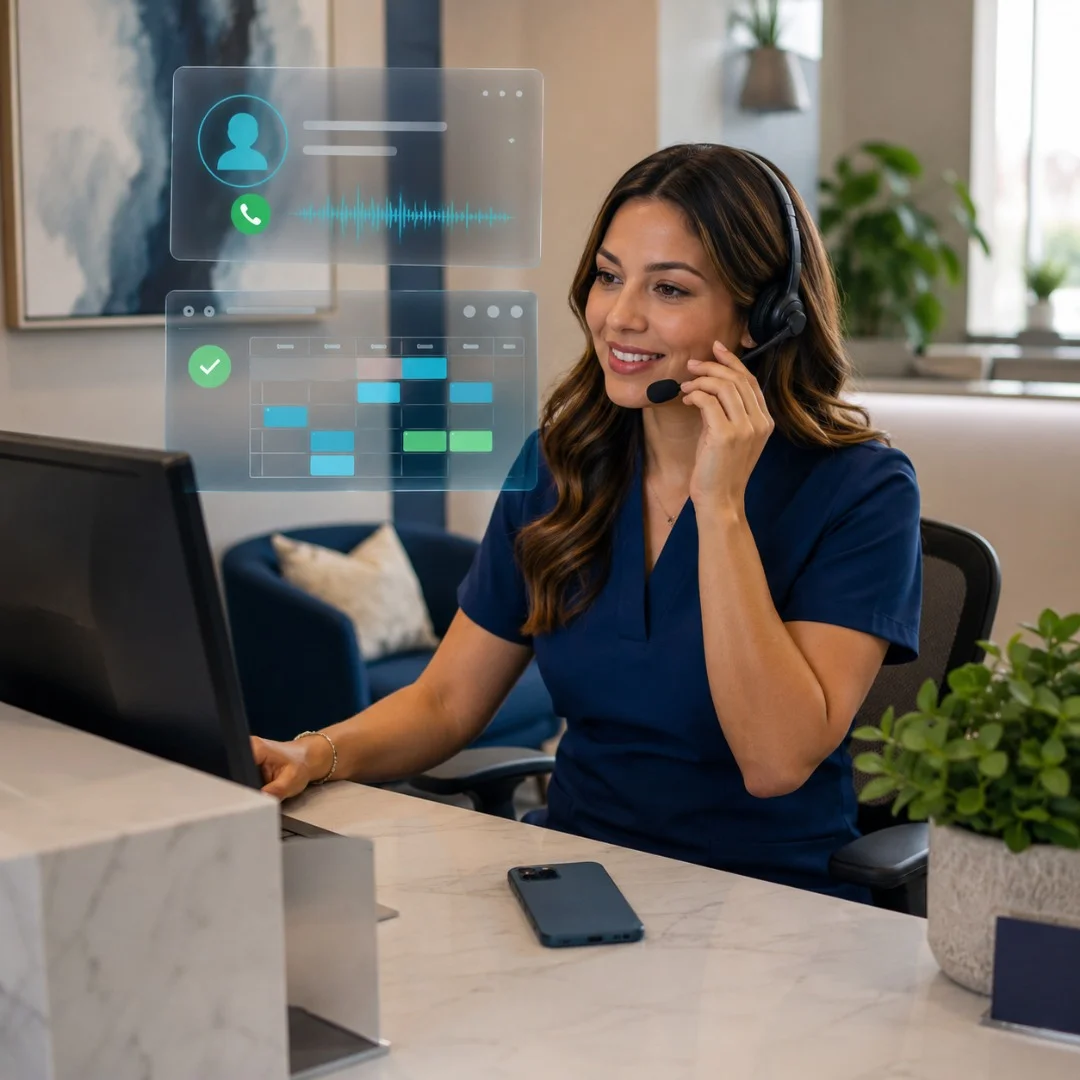
AI helps med spas capture those missed calls and keep the calendar full. An AI voice agent answers when your front desk cannot, handles routine questions, and books the appointment, while automated reminders cut no-shows. People still handle every consultation and every clinical question. This article covers the missed-call problem, what AI can and cannot do in an aesthetics practice, the math of a missed call, and how to start.
H2: Why med spa front desks miss so many calls
Medical aesthetics is large and growing, with more than 11,000 medical spas in the United States, so a prospective client who cannot reach you has plenty of other practices to try. Yet the busier a med spa gets, the more calls it misses, for reasons that have nothing to do with the quality of care:
The front desk is with a client. Check-in, checkout, and payment all happen at the same desk that answers the phone. When a client is standing there, the phone loses.
Treatments pull staff away. During a procedure, no one is free to pick up.
Calls come after hours. People research and book treatments in the evening and on weekends, when the practice is closed, and during short lunch or turnover gaps when the desk is unmanned.
Every one of those missed calls is a prospective client who was ready enough to pick up the phone, and most will not call back.
H2: What a missed call really costs
You do not need an industry statistic to see the cost. Run the arithmetic with your own numbers:
Estimate how many calls your practice misses in a typical week, including after-hours calls.
Estimate the share that were prospective clients trying to book, not existing clients.
Multiply by the share you would realistically convert into a booked appointment.
Multiply that by what an average client is worth to you. Here is what makes aesthetics different: a client often returns for repeat treatments, so use their value over time, not just the first visit.
That figure is your illustrative missed-call cost, an estimate built from your own volume and client value, not a promise or a fixed number, and results depend on your call patterns, conversion, and follow-up. Most owners are surprised by how large it is once repeat visits are counted.
H2: How AI voice agents and automation help
The fix is a system that answers every call and keeps the calendar full. For a med spa, that usually combines a few pieces:
An AI voice agent answers the calls your desk cannot. After hours, during treatments, or when the front desk is busy, it picks up, answers routine questions about hours, location, and general service offerings, and books the appointment.
It captures and qualifies the inquiry. The agent collects the caller's name, contact details, and interest, then books or routes them, so no lead is lost to voicemail.
Automated booking and reminders keep the schedule full. Confirmations and reminders reduce no-shows, and easy rescheduling turns conflicts into kept appointments. This is the same scheduling backbone we cover in Appointment Scheduling Automation: Fill the Calendar and Cut No-Shows (https://www.prismagentsolutions.com/blog/appointment-scheduling-automation).
Everything lands in your CRM. Each captured call and booking is logged in one place, so follow-up stays organized.
This is one practical version of a larger idea, serving more clients without adding front-desk staff, which we cover in How AI Helps You Handle More Customers Without Hiring (https://www.prismagentsolutions.com/blog/handle-more-customers-without-hiring).
H2: The human handoff: where AI stops and your team begins
This boundary is not optional in an aesthetics practice, and it is what makes automation appropriate here. AI voice agents answer, qualify, book, and route, and nothing more. They do not give medical or clinical advice, make claims about treatments or outcomes, or handle regulated or high-stakes questions.
The moment a caller asks about candidacy for a procedure, medical history, contraindications, expected results, or anything clinical, the system hands off to a qualified person. People handle every consultation and every medical, clinical, or regulated question. The AI's job is to connect that person with your team, not to stand in for your team's expertise. Kept clear, this line lets a med spa capture more bookings without putting automation where human judgment and licensed care belong.
H2: How to start
You do not need to change how your practice delivers care to fix how it answers the phone. Start small:
1. Find your worst gap. After-hours calls, treatment-time calls, or the lunch window, whichever costs you the most bookings.
2. Add call coverage there first. Put an AI voice agent on the calls you miss most, so they get answered and booked.
3. Turn on confirmations and reminders. Cut no-shows on the appointments you already have.
4. Keep the handoff clear. Make sure any clinical or consultation question routes straight to your team.
5. Review and expand. After a few weeks, look at captured calls and bookings, then extend coverage.
Each step is small, reversible, and closes a gap where bookings leak.
H2: Frequently asked questions
H3: Can AI really help my med spa book more clients?
It helps by capturing bookings you currently lose to voicemail. An AI voice agent answers the calls your front desk cannot and books them, so ready-to-book callers reach your calendar instead of the next practice.
H3: Will an AI voice agent give medical or treatment advice?
No. It answers routine questions and books appointments only. Any clinical, medical, or regulated question, including candidacy, results, or contraindications, is handed off to a qualified person on your team. The AI never gives medical advice.
H3: Will callers know they are talking to an AI, and will it feel impersonal?
Handled well, callers experience a practice that answers promptly and books them without voicemail. The agent is clear and helpful, and it passes anything sensitive to a person, so the human relationship your clients value stays intact.
H3: What happens to calls that come in after hours?
Instead of going to voicemail, they are answered. The agent captures the inquiry and books the appointment, so evening and weekend interest becomes a scheduled visit rather than a lost lead.
H3: How does this connect to my scheduling and CRM?
Bookings sync to one calendar and every captured call is logged in your CRM, which keeps the schedule accurate and makes follow-up organized instead of scattered.
H2: Ready to stop sending clients to voicemail?
If your front desk cannot catch every call, the bookings you are missing are likely worth more than you think, especially over a client's repeat visits. Get Your Free AI Assessment and we will look at where your calls slip today and how an AI voice agent and booking automation could capture more of them, while your team keeps doing the work only people should do.